
News
EN ISO 20471 vs ANSI/ISEA 107: Which Standard Does Your Market Require?
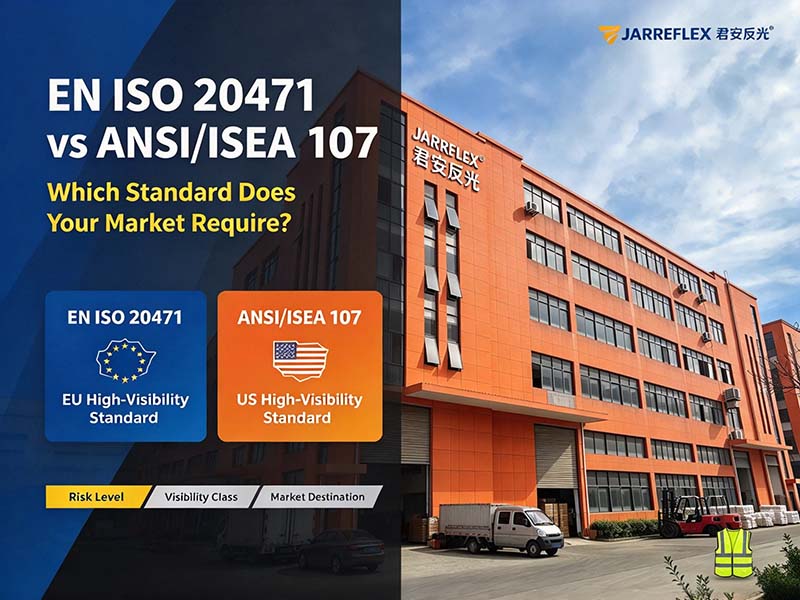
The cheapest vest is the one that never causes a recall, a customs rejection, or a workplace incident. Before you wire a deposit to any Chinese manufacturer, run these seven checks — they separate compliant factories from trading companies that merely claim to be factories.
1. Verify the Factory, Not Just the “Company”
China’s PPE sector is crowded with trading companies posing as manufacturers. A real factory will readily share its business license showing “生产制造” (manufacturing) as the business type, along with a plant address you can cross-check on a map.
Ask for a live video walkthrough of the production floor — not a pre-recorded marketing video. A legitimate manufacturer will show sewing lines, cutting tables, and quality control stations in real time. If they deflect or send only stock footage, you are likely dealing with a middleman
Regional clusters offer different strengths: Zhejiang for high-volume reflective tape integration, Guangdong for rapid prototyping and export logistics, Jiangsu for technical innovation and certification compliance, and inland provinces like Henan for cost-effective bulk production.
2. Confirm Certifications — and Verify Them Independently
What to ask for:
-
EN ISO 20471 test reports (for EU market) or ANSI/ISEA 107-2020 certification (for North America)
-
ISO 9001 quality management system certificate
-
Third-party test reports from SGS, TÜV, Intertek, or UL
How to verify: Do not accept a scanned certificate at face value. Contact the issuing body directly, or request batch-specific test data that ties the report to the exact production run you are ordering. Some factories now offer blockchain-based traceability for material sourcing.
A compliant factory will have its own testing lab with calibrated retroreflectometers and colorfastness equipment. Jiangxi Nanmeiyi, for example, operates an in-house lab capable of testing to US, EU, and Australian standards, with staff holding UL certification training.
3. Inspect Raw Material Specifications
The vest is only as good as its materials. Request material test reports for:
| Component | What to Verify |
|---|---|
| Fluorescent fabric | Colorfastness to washing and light; weight ≥120g/m² for durability |
| Reflective tape | Retroreflective coefficient (minimum 330 cd/lx/m² for EN ISO 20471); wash durability cycles |
| Stitching | 6–8 stitches per cm; reinforced stress points |
Ask whether the reflective tape comes from a certified supplier (3M, or equivalent certified brands). Some factories will substitute uncertified tape to cut costs — this is the most common point of failure in rejected shipments.
4. Review Quality Control Systems, Not Just Claims
A factory that says “we have strict QC” means nothing. Ask for:
-
In-house QC equipment list (retroreflectometer, spectrophotometer, wash testing machine)
-
AQL (Acceptable Quality Limit) standards used for inspection
-
In-line and final inspection protocols
Professional factories implement statistical process control (SPC) for critical parameters like reflectivity and color values. They maintain batch-specific inspection records and welcome third-party pre-shipment inspections without resistance.
If a factory refuses third-party inspection access, walk away.
5. Check Real-World Performance Metrics
Past performance predicts future reliability. Request these data points:
-
On-time delivery rate — target ≥97%
-
Reorder rate — target ≥30%, indicating customer satisfaction
-
Response time — ≤2 hours for B2B inquiries is standard for reliable suppliers
Platforms like Alibaba and Made-in-China display some of these metrics publicly. A factory with a 5.0 rating and high reorder rate has earned that track record over years.
6. Test Samples Before Bulk Commitment
Never place a bulk order without physically testing a sample. What to evaluate:
-
Reflectivity under low-light conditions — use a photometric device if available
-
Seam strength — pull test stress points
-
Fabric breathability and comfort — especially for warm-climate markets
-
Wash durability — run 25+ wash cycles and re-test reflectivity
A factory confident in its product will offer samples quickly and without excessive charges. Some manufacturers provide 7-day sample delivery as standard.
7. Clarify Your Compliance Specification in Writing
Before ordering, document exactly what standard your product must meet and at what performance class. A vague specification like “high visibility vest” is an invitation for disputes.
Your spec sheet should state:
-
Applicable standard (EN ISO 20471 Class 2, or ANSI/ISEA 107 Type R Class 2, etc.)
-
Minimum reflective tape area
-
Colorfastness requirements
-
Labeling and packaging requirements
-
AQL inspection standard
One factory owner put it bluntly: “The cheapest hi-vis vest is not the one with the lowest unit price — it’s the one that never triggers a compliance issue, a lawsuit, or a recall. The real cost of that vest is its initial price, and nothing more”

