
News
LED vs Passive Reflective Gear: What Sells Better in 2026?
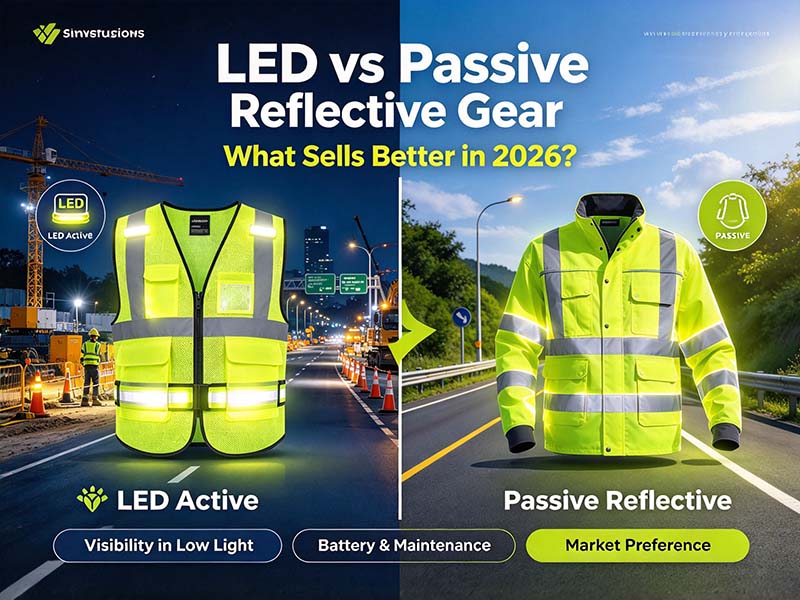
The market is splitting. Passive reflective gear still dominates by volume in industrial and construction channels. LED active lighting is winning in cycling, running, and consumer safety categories. If you are a distributor or brand deciding what to stock, the answer depends on your end-user, not on which technology is “better.”
The Numbers: Two Markets Moving in Different Directions
The global high-visibility clothing market — dominated by passive reflective materials — was valued at $2.04 billion in 2025**, growing to **$2.21 billion in 2026 at a CAGR of 8.2%. This is the core industrial market: construction vests, work jackets, safety pants. Passive reflective tape remains the default compliance solution because it meets EN ISO 20471 and ANSI/ISEA 107 without batteries, charging, or electronics.
LED-powered safety gear tells a different story. The global light-emitting safety wraps market (LED armbands, ankle bands, clip-on devices) reached $347 million in 2025**, projected to hit **$707 million by 2032 at a 10.7% CAGR. The growth rate is higher, but the base is roughly one-sixth the size.
The more telling split appears in cycling-specific gear. One report puts the global light-emitting safety cycling apparel market at $485 million in 2026, with active LED products capturing 35% market share and growing at 12.5% year-over-year. Another estimates LED-active cycling gear at 60.4% of the market in 2025, with passive reflective patches declining from 32% market share in 2020 to 24% in 2025.
The discrepancy between these figures reflects a real split in how the market is measured: cycling-specific vs. all safety wearables. The directional signal is consistent: LED is taking share in consumer mobility categories.
Why Passive Reflective Still Wins in Industrial Channels
Construction, utilities, manufacturing, and public safety remain passive reflective territory. The reasons are structural, not technological.
Compliance drives purchasing. EN ISO 20471 and ANSI/ISEA 107 are built around retroreflective material performance. A passive vest meets the standard with no power source, no charging, no batteries to fail mid-shift. LED garments have no equivalent mandatory standard in most industrial PPE categories — ANSI/ISEA 107-2025 added “electronic lighting component” testing provisions, but passive reflective remains the baseline compliance path.
Total cost of ownership favors passive. An industrial safety manager buying 500 vests for a construction crew needs garments that survive 50+ industrial wash cycles and never run out of power. LED garments introduce battery management, charging infrastructure, and electronic failure points into a procurement process that prizes simplicity. As one construction buyer guide puts it, the real metric is “cost per wear, not cost per vest” — and passive gear still wins on that calculation for high-volume industrial use.
The 2026 ANSI/ISEA revision reinforces passive baseline. The proposed sixth revision of ANSI/ISEA 107, opened for public review in March 2026, focuses on updated testing protocols and nighttime visibility assessment — not on mandating electronic lighting. The compliance framework remains passive-reflective centric.
Where LED Gear Is Winning
LED safety gear is gaining traction in three distinct categories, each with different buying behavior.
Cycling and micro-mobility. This is the breakout category. Urban cycling, e-bike commuting, and shared micro-mobility users face a visibility problem that passive reflectors only partially solve: reflective material requires an external light source (headlights) to function. LED provides self-illumination. As e-bike and shared scooter adoption accelerates, a new user base of non-professional riders is driving demand for gear that is both visible and stylish. LED-powered cycling apparel is projected to capture a growing share of this market through 2030.
Consumer safety wearables. LED armbands, clip-on lights, and safety pendants have a price point ($12–$20 average) and retail channel (Amazon, sporting goods, cycling shops) that passive industrial vests do not reach. This is a B2C market where consumers buy for themselves or their families — for night running, dog walking, or child safety. Brand, design, and convenience matter as much as compliance.
Premium and smart segments. Integrated LED systems with motion sensors, turn signals, and smartphone connectivity are emerging in premium cycling and motorcycle gear. These products sell at $180+ per unit and are growing through specialist retail and DTC channels. The technology is advancing: flexible circuits, washable electronics (80+ machine wash cycles), and battery life of 8–12 hours are now feasible.
The Regional Divide
North America is the fastest-growing region for high-visibility clothing overall, with a mature, compliance-driven industrial market and a rapidly growing consumer cycling segment. US buyers in industrial channels default to passive; consumer channels are more open to LED.
Europe has the most developed LED cycling market, driven by strict nighttime visibility regulations and high cycling adoption. EU regulations updated in 2024–2025 brought active lighting into non-professional visibility standards, requiring minimum 4-hour continuous operation for compliant products. This regulatory recognition is a significant unlock for LED products.
Asia-Pacific is the largest and fastest-growing region by volume, but the mix skews differently. China, India, and Southeast Asia have massive e-bike and shared bike populations and price-sensitive buyers. Passive reflective gear dominates on cost; LED adoption is growing fastest in mid-to-premium segments.
What This Means for Buyers and Brands
If you sell to industrial, construction, or utility buyers: passive reflective remains the volume play. Invest in wash durability, comfort, and compliance documentation. LED is not replacing this market — it is complementing it in specific high-risk nighttime applications.
If you sell to cyclists, runners, or consumer safety buyers: LED is the growth category. Passive reflective gear has a role as a baseline, but the willingness to pay a premium for active illumination is real and growing. The smart play is often a hybrid: passive reflective base + LED accent for night use.
If you are a distributor building a portfolio: the two technologies serve different customers. Stocking both is not hedging — it is segment coverage. The passive vest and the LED armband rarely compete for the same purchase order.

